Jet lag can turn an exciting trip into a few days of tiredness, poor sleep, headaches, and difficulty concentrating. Whether you’re traveling across Canada, flying to Europe, or taking a long-haul trip to Asia, crossing multiple time zones can temporarily confuse your body’s internal clock.
The good news is that jet lag usually improves as your body adjusts to the new local time. With a little planning before and during your trip, you can make that adjustment easier.
What Is Jet Lag?
Jet lag happens when your internal body clock is out of sync with the local time at your destination.
Your body has a natural sleep-wake rhythm, often called the circadian rhythm. It helps regulate when you feel sleepy, when you wake up, body temperature, hormones, and other daily functions.
When you suddenly travel across several time zones, your body may still think it is nighttime when the local clock says it is daytime.
For example, you may arrive in London at 8 a.m., but your body could feel as though it is still 1 a.m. in Calgary.
That mismatch can make you feel exhausted even though the local day has just begun.
Common Symptoms of Jet Lag
Jet lag affects people differently, but common symptoms include:
- Difficulty falling asleep
- Waking up too early
- Feeling sleepy during the day
- Fatigue and low energy
- Difficulty concentrating
- Headaches
- Irritability or mood changes
- Reduced appetite
- General feeling of being “out of sync”
The more time zones you cross, the more noticeable jet lag can become.
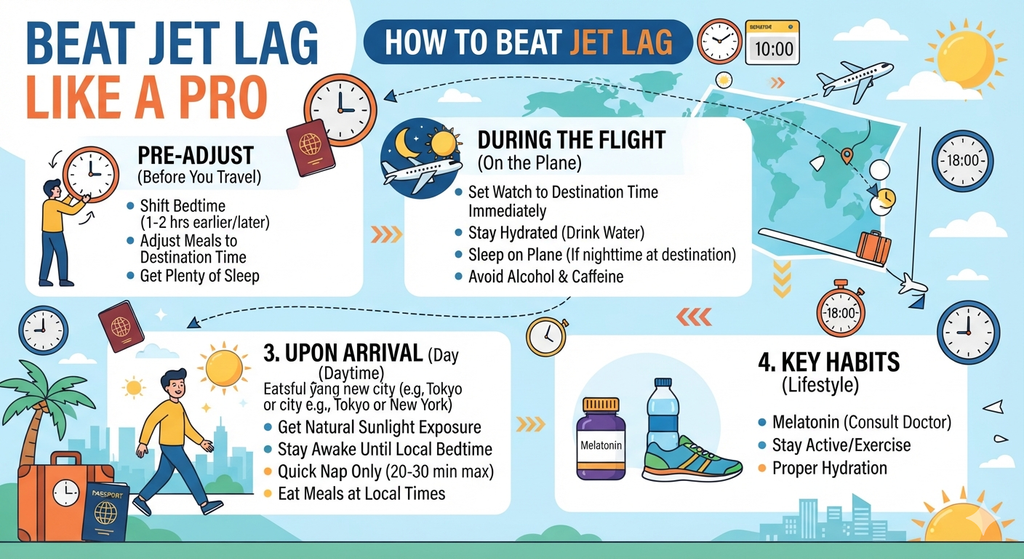
How to Beat Jet Lag
1. Start Adjusting Your Sleep Before Your Trip
If you know you’re traveling several time zones away, don’t wait until you arrive to change your schedule.
For a few days before departure, gradually move your bedtime and wake-up time toward the schedule you’ll follow at your destination.
You don’t have to make a dramatic change overnight. Even small adjustments can make the transition easier.
2. Get Light at the Right Time
Light is one of the strongest signals that helps your body clock understand when it should be awake and when it should prepare for sleep.
After arriving, try to spend time outdoors during the appropriate part of the local day.
However, the timing matters. Morning light and evening light can affect your body clock differently depending on whether you’ve traveled east or west.
For major time-zone changes, planning your light exposure around your destination’s local time can be more useful than simply trying to get as much sunlight as possible.
3. Switch to Local Time Quickly
Once you arrive, try to follow the destination’s schedule.
If it is lunchtime, eat lunch.
If it is evening, start preparing for bedtime.
It can be tempting to continue following the time zone you left behind, but staying on the old schedule can make it harder for your body to adjust.
4. Avoid Long Naps
A short nap can sometimes help when you’re extremely tired, but sleeping for several hours during the day may make it harder to sleep at night.
If you need a nap, keep it relatively short and avoid turning it into a second night’s sleep.
Your goal is to build enough sleep pressure to sleep at the appropriate local bedtime.
5. Stay Hydrated
Long flights can leave you feeling dehydrated and uncomfortable.
Drink water regularly during your journey and after arriving.
Try not to rely heavily on alcohol to help you sleep on the plane. Alcohol can disrupt sleep quality and may leave you feeling worse after the flight.
6. Be Careful With Caffeine
Caffeine can help you stay alert when you’re tired, but using it too late in the local day can interfere with nighttime sleep.
If you’re trying to reset your sleep schedule, consider limiting caffeine later in the day.
A simple rule is to use caffeine strategically rather than continuously throughout the day.
7. Eat According to Local Time
Your sleep isn’t the only thing affected by a long journey.
Your body also uses regular meal timing as a signal.
After arriving, gradually move your meals to local breakfast, lunch, and dinner times.
Choosing lighter meals when you’re tired may also help you feel more comfortable during the adjustment period.
8. Make Your First Night Sleep-Friendly
When bedtime arrives, make your bedroom as comfortable as possible.
Keep the room:
- Dark
- Quiet
- Comfortable
- Cool enough for sleeping
Put your phone away if you find yourself scrolling instead of sleeping.
A consistent bedtime routine can also help your brain recognize that it is time to wind down.
9. Don’t Stress About One Bad Night
One poor night of sleep doesn’t mean your entire trip will be ruined.
Jet lag is temporary, and your body generally needs some time to synchronize with the new time zone.
Instead of constantly checking the clock and worrying about how little you’ve slept, focus on getting back onto the local schedule the following day.
How Long Does Jet Lag Last?
There isn’t one exact recovery time for everyone.
The number of time zones crossed, direction of travel, sleep schedule, light exposure, age, and individual differences can all affect how quickly someone adjusts.
Eastward travel can often be more challenging because it requires your body clock to shift earlier, while westward travel generally requires shifting later.
Jet Lag After Flying East vs. West
The direction of travel matters.
Traveling East
When traveling east, you usually need to go to sleep and wake up earlier than your body is accustomed to.
For example, traveling from Canada to Europe may require your body clock to advance.
Traveling West
When traveling west, you generally need to stay awake and sleep later.
For example, traveling from Canada toward the western United States may require a delay in your body clock.
Understanding the direction you’re traveling can help you plan your sleep and light exposure more effectively.
Should You Sleep on the Plane?
It depends on the timing of your flight and your destination.
If your flight corresponds to nighttime at your destination, sleeping on the plane may help you transition toward the new schedule.
If it corresponds to daytime at your destination, staying awake may make it easier to adapt.
Comfortable clothing, an eye mask, and a supportive travel pillow can make sleeping on a long flight easier.
Can a Jet Lag Calculator Help?
Yes. A jet lag calculator can help you organize your sleep and light exposure around your travel schedule.
Instead of guessing when to sleep, wake up, seek bright light, or avoid light, you can create a personalized plan based on:
- Departure location
- Destination
- Departure time
- Arrival time
- Number of time zones crossed
- Direction of travel
A personalized schedule can be particularly useful for long international trips.
A Simple Jet Lag Recovery Plan
Here’s an easy example.
Before your flight:
Gradually adjust your bedtime toward your destination’s schedule.
During the flight:
Try to sleep or stay awake according to the destination’s local time when practical.
After landing:
Follow the local schedule immediately.
During the day:
Get appropriately timed outdoor light and remain active.
At night:
Keep your bedroom dark and follow a relaxing bedtime routine.
The following days:
Continue following local wake-up, meal, activity, and bedtime schedules.
Final Thoughts
Jet lag can be frustrating, but it doesn’t have to ruin your vacation or business trip.
The most important things are to adapt to local time, use light strategically, avoid excessive daytime sleeping, stay hydrated, and give your body time to adjust.
If you’re planning a long-distance trip, creating a jet lag schedule before you fly can make the transition much easier.
Planning a trip across multiple time zones? Use a jet lag calculator to create a personalized sleep-adjustment plan before you travel.