guidelines for last nap for babies
If you’ve ever wondered, “Is my baby taking their last nap too early or too late?” you’re definitely not alone. It’s one of the most common questions parents ask, especially when bedtime suddenly becomes a struggle.
The timing of your baby’s last nap can have a big impact on how the evening goes. If the nap ends too early, your little one may become overtired and extra fussy by bedtime. If it ends too late, they might not be tired enough to fall asleep when you want them to.
The good news is that there’s no need to guess. While every baby is different, there are general guidelines that can help you find a routine that works.
Why the Last Nap Is So Important
Think of your baby’s last nap as the bridge between daytime sleep and bedtime. A well-timed nap helps your baby stay rested without making it harder to fall asleep at night.
When the timing is right, you may notice that your baby:
- Falls asleep more easily at bedtime
- Sleeps for longer stretches during the night
- Wakes up in a better mood
- Is less fussy in the evening
As babies grow, their sleep needs change. They’ll gradually take fewer naps, and the timing of that final nap will shift too.
When Should the Last Nap End?
Here are some general recommendations based on age.
Newborn (0–3 Months)
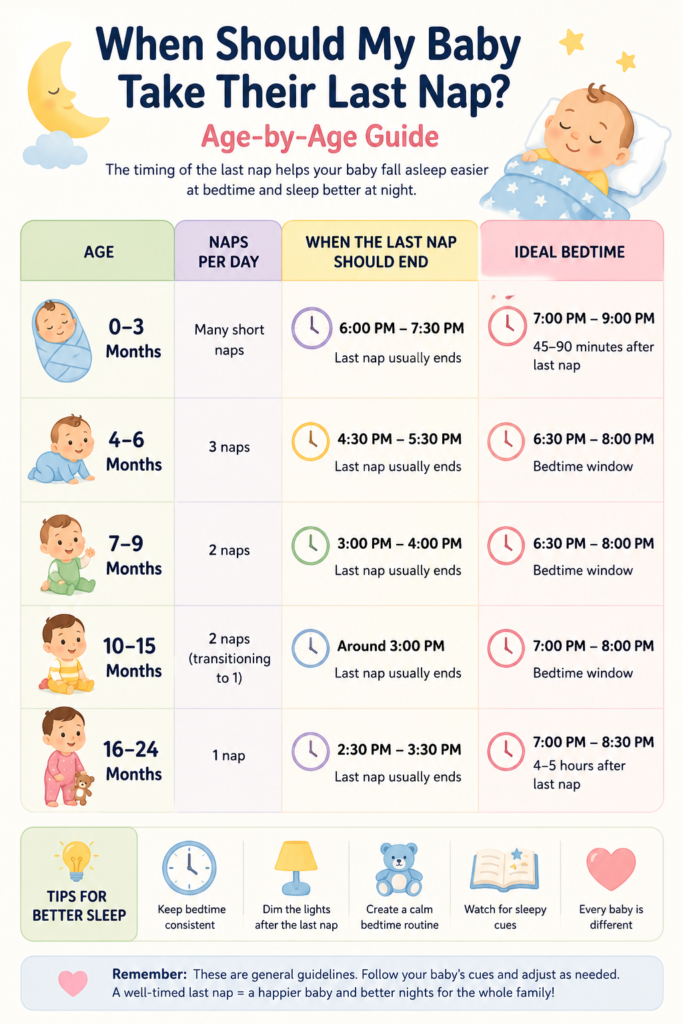
Newborns spend much of the day sleeping, so they don’t have a fixed nap schedule yet. Their last nap often ends sometime between 6:00 PM and 7:30 PM, followed by bedtime about 45 to 90 minutes later.
At this stage, don’t worry too much about exact times. Focus on feeding, comforting, and watching for sleepy cues.
4–6 Months
Around four months, many babies begin following a more predictable routine. Most take three naps during the day, with the final nap ending around 4:30 PM to 5:30 PM.
A bedtime between 6:30 PM and 8:00 PM usually works well for many babies in this age group.
7–9 Months
By now, many babies have dropped to two naps a day. The afternoon nap often finishes between 3:00 PM and 4:00 PM, leaving enough time to build sleep pressure before bedtime.
10–15 Months
Most babies still take two naps, although some begin transitioning to one. The final nap commonly ends around 3:00 PM, with bedtime a few hours later.
16–24 Months
Toddlers usually settle into one afternoon nap that ends between 2:30 PM and 3:30 PM. After that, they’ll typically stay awake for 4 to 5 hours before bedtime.
How Do You Know If the Last Nap Needs to Change?
Babies don’t read schedules, so it’s normal for routines to change as they grow.
Your baby’s last nap might need adjusting if they:
- Fight bedtime every night
- Take more than 30 minutes to fall asleep
- Wake up several times overnight
- Wake very early in the morning
- Regularly refuse the last nap
- Become extremely cranky before bed
If you’re seeing these signs, try shifting the last nap or bedtime by 15 to 30 minutes and see if things improve over the next few days.
Don’t Forget About Wake Windows
Rather than focusing only on the clock, pay attention to how long your baby has been awake.
Wake windows are simply the amount of time babies can comfortably stay awake before they become tired again.
As a general guide:
- Newborns usually stay awake for 45 to 90 minutes.
- Babies around 4–6 months often manage 2 to 3 hours.
- Older babies may stay awake for 3 to 4 hours.
- Toddlers often manage 4 to 5 hours before bedtime.
Keeping your baby’s wake windows in mind can make it much easier to find the right bedtime.
A Few Tips for Smoother Evenings
Small habits can make bedtime feel much less stressful.
Try to:
- Keep bedtime around the same time each evening.
- Dim the lights after the last nap.
- Avoid exciting play right before bed.
- Read a short book or sing a lullaby.
- Watch for sleepy signs like yawning, rubbing eyes, or staring into space.
A calm, predictable routine helps many babies understand that bedtime is coming.
Frequently Asked Questions
What if my baby skips the last nap?
It happens! If your baby refuses the final nap, consider putting them to bed 30 to 60 minutes earlier than usual. An earlier bedtime is often better than keeping an overtired baby awake.
Can the last nap be too late?
Yes. A nap that ends too close to bedtime can make it harder for your baby to fall asleep because they simply aren’t tired enough yet.
Should I wake my baby from the last nap?
Sometimes. If a late-afternoon nap is running long and pushing bedtime much later than usual, gently waking your baby may help keep their sleep schedule on track.
Will every baby follow these times exactly?
Not at all. These recommendations are meant to be helpful guidelines. Every baby develops at their own pace, so it’s perfectly normal to make small adjustments based on your child’s needs.
Finding the right time for your baby’s last nap doesn’t have to be complicated. Start with age-based recommendations, pay attention to your baby’s sleepy cues, and don’t be afraid to make small adjustments along the way.
Remember, no two babies are exactly alike. Some will be ready for bed a little earlier, while others need a bit more awake time. The goal isn’t to follow a perfect schedule—it’s to find a routine that helps your baby get the restful sleep they need.
If you’re still unsure, try using our Nap Time Calculator. It can help you estimate the best nap times, wake windows, and bedtime based on your baby’s age and daily routine, making it easier to build a schedule that works for your family.